


Data Quality and Governance
Purpose of this Quick Start Guide
The purpose of this guide is to define and illustrate the benefits of Data Governance and Data Management, with specific attention paid to how maintaining robust processes maximizes the effective utilization of the UDI and ensures trading partners are working with consistent, accurate information.
The guide also highlights best practices in data governance and management.
Terminology
See the Glossary Quick Start Guide for the definitions for any unfamiliar terms or acronyms.
Data Governance
Data governance can be defined as the strategic framework of policies, roles, and processes that ensure an organization’s data is secure, accurate, available, and usable throughout its lifecycle. Data governance is different from data management in that is focuses on “how” data is handled (rules and accountability) and governed versus technical execution of data storage or processing. Additionally, Data governance is an ongoing process and program, not a project.
Most manufacturers and some health care providers have organization-wide data governance processes. In such cases, supply chain serves as the data steward (expert) for all relevant supply chain data as part of a larger data governance role. If an organization-wide data governance program doesn’t exist, supply chain can put policies and procedures in place to govern its own data.
Data Management
Data can be defined as the ongoing, systematic process of cleaning, updating and organizing data to ensure it remains accurate, consistent, secure and usable throughout its lifetime. It involves both complex tasks of matching and validating equivalent data across multiple data sources, as well as routine tasks such as removing duplicates, correcting errors, updating records, and ensuring data security to support reliable decision-making. Unlike one-time data cleansing, it requires a continuous, proactive process to manage data health.
Benefits of Data Governance and Management
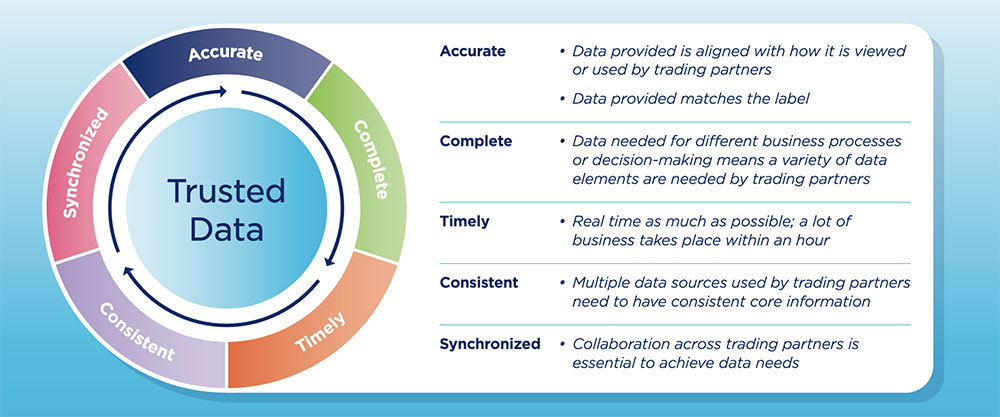
One of the key benefits of strong data governance and management programs is the creation of trusted data. Trusted data is the foundation for all decision-making and trading partner relationships. There are many definitions and depictions of trusted data, with most referencing data that is accurate, complete, consistent, curated, verified, timely, and secure.
The following is a helpful illustration of factors that contribute to trusted data.
Health Care Provider Best Practices
- Determine if your organization has a formal data governance process, and if yes, define the process and role for managing supply chain data within that process.
- Prioritize internal training. Make sure internal teams are educated on the UDI and understand their role in the organization’s data governance process. Optimize the use of the UDI across the organization and embed it in all business processes.
- Create and document the data management process for supply chain data. The following are examples of things to include:
- The process for adding, changing, or deleting data, including who can authorize the change and who can change information in each IT system.
- A change control process that documents the details of all changes.
- A guide that outlines the accountability of supply chain, clinical users, and IT in identifying and communicating necessary changes.
- Develop a specific plan for handling UDI-DI changes. This should include roles and responsibilities for all stakeholders (including manufacturers) and how to synchronize the change between the ERP, EHR and inventory management systems. Consider cross-team visibility across clinical, supply chain and IT stakeholders.
- Identify the source for each data element. Source examples include the manufacturer, GUDID, GPOs and data management organizations. For each data source, identify a contact(s) who is responsible for assisting with data issues.
Manufacturer Best Practices
Most manufacturers have established data governance and data management programs to support compliance with regulatory requirements and may not focus on data management issues with their customers and other downstream stakeholders. Best practices for being more proactive with these stakeholders include:
- Develop a process to communicate UDI-DI changes, including why the UDI-DI changed, when packaging will change, and an anticipated date when existing inventory will be depleted
- Implement an annual process to review all items in the Global UDI Database (GUDID) and ensure all information is correct.
- Monitor and ensure that data updates to GUDID are submitted using the following criteria:
- Label Changes: If the change impacts the device label, the GUDID must be updated no later than the date the device is first labeled with the new information.
- Non-Label Changes: If the updated information does not appear on the label, it must be submitted within 10 business days following the change.
- Prioritize internal training. Make sure internal teams are educated on the UDI and understand their role in the organization’s data governance process.
- Optimize the use of the UDI across the organization and embed it in all business processes.
Data Management Organization Best Practice
There are a variety of services provided by data management organizations that can be of assistance to health care providers. These organizations can provide data cleansing, data augmentation and processes for keeping data updated and accurate. However, the overall responsibility for health care provider data governance and management rests with that health care provider. Best practices to expect from data management organizations include:
- Maintain a documented data source hierarchy. Health systems should be able to see exactly where each data element came from and how much to trust it. Primary sources like the GUDID, accredited UDI issuing agencies, and direct manufacturer feeds should be clearly separated from derived or inferred data.
- Communicate proactively when source data changes. UDI-DI changes, product discontinuations, and GUDID corrections all have downstream consequences for the health system. Vendors should communicate these changes with enough lead time for the hospital to manage the impact.
- Be transparent about how items are matched. When a hospital item is linked to a manufacturer record, document the matching logic, whether it was an exact UDI-DI match, a catalog number match, or a probabilistic match. Data stewards need to be able to validate or challenge that linkage.
- Build an automated feedback channel. Health systems can help find errors. Vendors should have a structured way to receive data quality feedback and a clear process for investigating and resolving it. One-way data delivery is not a governance partnership.
- Keep an audit trail. Every data change should be logged with what changed, when, and why. Health systems need this to run compliant governance programs.
- Align with established standard organizations, such as accredited UDI Issuing agencies for product identification, ANSI X12 for unit of measure, HL7 FHIR for clinical data standards, UNSPSC and GMDN for commodity classification, GUDID for device identification, and HCPCS for clinical charge linkage. Aligning to established standards helps ensure data can move consistently across trading partners and systems.
- Support the health system’s own business rules. Every hospital is a little different. Vendors should allow health systems to apply their own governance rules, e.g., description format standards, exclusion criteria, UOM preferences, etc., on top of the standardized data layer.
Resources:
AHRMM LUC UDI Change Communication Process
Enterprise Information Management: Best Practices in Data Governance
GS1 US Guide to Managing and Measuring Data Quality in Healthcare
GS1 US Best Practice Guide for Sharing Vital Attributes in Healthcare