


Benefits of Scanning the UDI at the Point of Care
Purpose of this Quick Start Guide
This guide outlines how automating capture of the UDI at the point of care supports:
- Accurate and compliant documentation of implant use in electronic health records, while reducing clerical burden on clinicians
- Improved patient safety by reducing potential use of recalled, expired or otherwise inappropriate devices
- Faster recall response
- Analytics around the cost and quality of care
Terminology
See the Glossary Quick Start Guide for the definitions to any unfamiliar terms or acronyms.
What is UDI?
The UDI is an FDA mandated code intended to improve patient safety by unambiguously identifying medical devices (from low to high-risk products) sold in the U.S. through distribution and use. Beyond patient safety, the UDI delivers a myriad of benefits across clinical, financial and supply chain functions. Manufacturers must obtain UDIs from one of three authorized issuing agencies for all of their products (unless specifically exempt) and label those products with the UDI in both human and machine-readable formats. The UDI consists of two parts: a device identifier (DI), which designates the specific make or model and packaging quantity (unit of measure) of a device, and a production identifier (PI) that includes the information used by manufacturers to control production of the product, such as lot, batch or serial number, expiry date and date of manufacture. For medical devices including human cell, tissue, cellular or tissue-based products, the UDI-PI also includes a code that can associate the device with the donor. Manufacturers must also publish additional data about their products in the Global UDI Database (GUDID), most of which is publicly accessible through AccessGUDID.
Under separate regulation from CMS and the ONC, health care providers are also required to use the UDI when documenting the use of implantable devices in electronic health records and in adverse event reports involving serious injury or death.
For more information on the UDI, see the “What is UDI” Quick Start Guide.
Benefits of Scanning at the Point of Care
Scanning the UDI barcode at the point of care or use ensures that medical device usage is documented accurately in the patient record, which in turn provides significant benefits for multiple parties as documented in the graphic below:
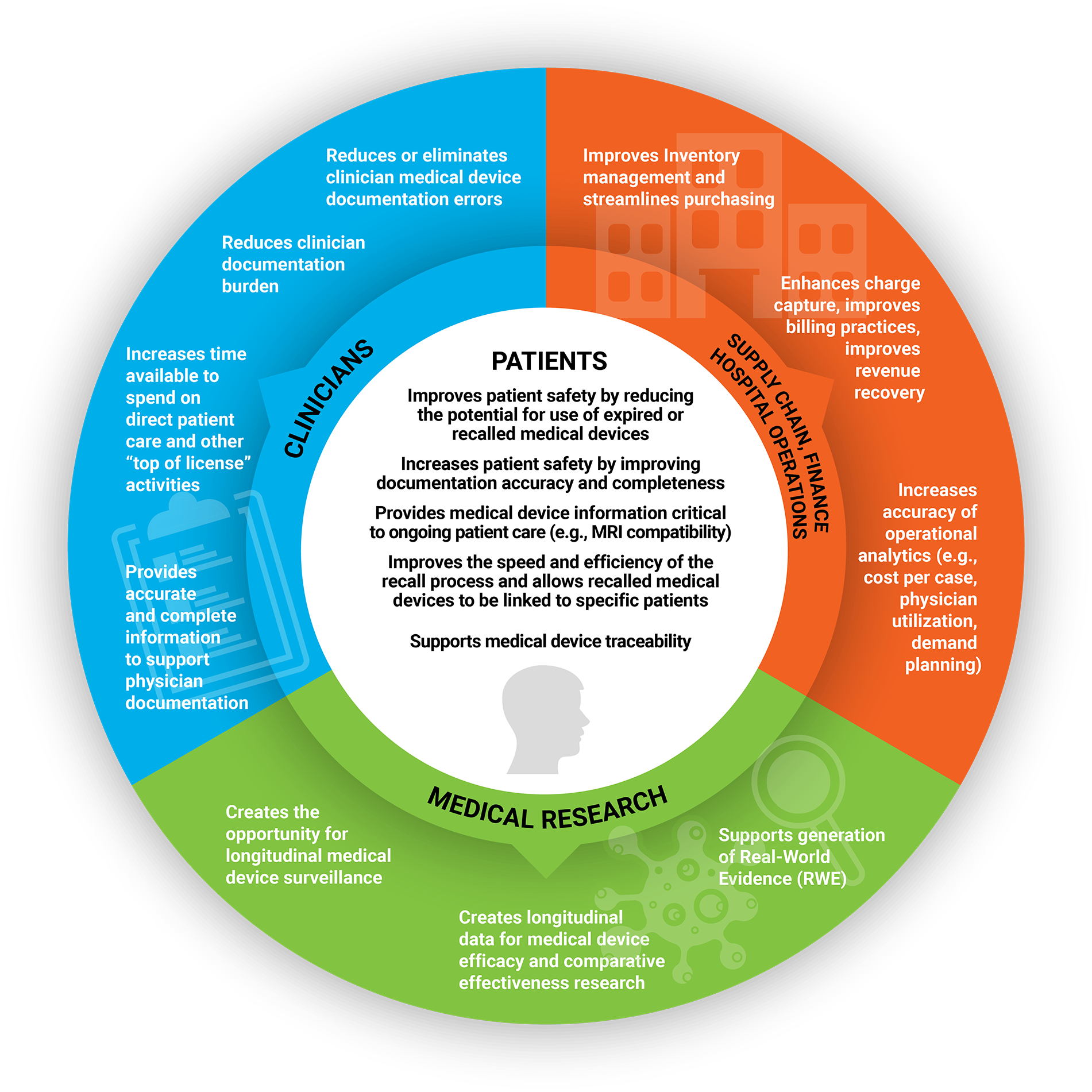
For more information on the full array of benefits UDI usage enables see the Benefits of UDI Quick Start Guide.
Gaining Support for Scanning at the Point of Care
The above outlined benefits are sufficient for some organizations to gain support and funding for implementation of barcode scanning at the point of care. Other organizations may choose to conduct a pilot program to quantify the benefits and understand staff concerns and pain points before scaling the program more broadly. The key to a successful pilot program is establishing a clear baseline. It may not be feasible to capture a baseline for all metrics (e.g., number of expired products used) but the more thorough the baseline, the more compelling the business case. Suggested baseline metrics to consider:
- The time required to manually document the UDI information for implanted medical devices.
- The number of instances when UDI-PI information is incomplete or missing in a random sample of patient records.
- The number of instances where device identifiers and other related information is inaccurate in a random sample of patient records (determined by comparing data to information in the Global UDI Database (GUDID) and available via AccessGUDID.
- The time required to manually review charts to identify patients who received recalled implantable devices.
- Clinical staff satisfaction with the manual documentation process and its impact on their availability to provide direct patient care.
These metrics can then be compared to those experienced after barcode scanning at the point of care is implemented for clinical documentation in order to quantify the benefits. Those benefits can then be compared to the cost incurred to implement the pilot.
 Click here to listen to Jimmy Tcheng, MD, Professor of Medicine, Duke University School of Medicine share the benefits from scanning at the point of care.
Resources
Making the Case for Standards and Scanning | HPN Online
Not Scanning UDI: What Are You Missing? | HPN OnlineUDI Gets a Collaborative Kickstart | HPN Online